How to Choose the Best Pockels Cells for Your Applications?
When selecting Pockels Cells for specific applications, several factors come into play. Pockels Cells are crucial in modulating light, making them essential for various optical setups. Understanding the right specifications is key to achieving optimal performance in your system.
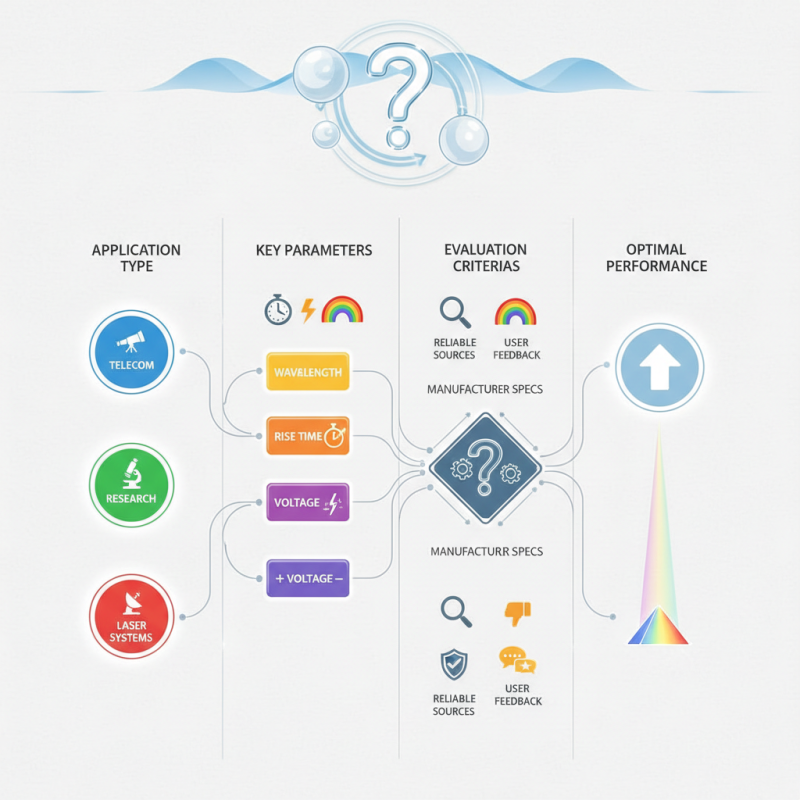
Different applications may require specific operational parameters. These include wavelength range, rise time, and voltage requirements. One must also consider the intended use—whether in telecommunications, scientific research, or laser systems. Each field has unique demands that Pockels Cells must meet.
It's important to note that not all Pockels Cells are created equal. Manufacturers often present varied performance specs, which may lead to confusion. It's essential to rely on reliable sources and reviews when making choices. Consider previous user feedback as this can guide your decision-making process.
Understanding Pockels Cells: Definitions and Basic Principles
Pockels cells are a type of electro-optic device. They modulate light using the Pockels effect. This principle involves changing the refractive index of certain materials when an electric field is applied. Understanding this fundamental operation is critical for selecting the right Pockels cells.
When considering Pockels cells, usage scenarios matter. Identify whether high speed or low loss is your priority. Different designs optimize for distinct applications. Take diode lasers; they require rapid modulation to maintain beam quality. Fiber lasers, however, may focus on minimizing insertion loss. Each characteristic impacts performance.
Tip: Always review the specifications of the materials used in Pockels cells. Not all crystals perform equally under varying wavelengths.
Furthermore, consider the configuration of your system. The physical layout can influence the effectiveness of modulation. In complex setups, user error might arise. Make sure to evaluate the interface with other optical components.
Tip: Experiment with various configurations if performance is subpar. Simple adjustments can lead to significant improvements.
Engaging with experts is advisable when making final decisions. They can offer insights that may not be obvious. Balance your options carefully to ensure precision in your applications.
Key Parameters for Selecting Pockels Cells in Optical Applications
When selecting Pockels cells for optical applications, several key parameters are vital. Understanding these can significantly enhance performance in your setup. The electro-optic coefficient is a primary factor. This coefficient dictates how effectively the Pockels cell can modulate light under an electric field. For instance, data suggests that a higher coefficient correlates with better light modulation efficiency, crucial in laser applications.
Another essential parameter is the damage threshold. It's critical to know the maximum power your Pockels cell can handle without degradation. In reports by optical research institutions, cells with higher damage thresholds show a longer lifespan and reliability. This aspect is especially important for high-energy laser systems, where repeated use may lead to quicker wear in lower-threshold units.
**Tip:** Consider the wavelength range for your application. Different Pockels cells perform better at specific wavelengths. Check the transmission spectrum to avoid losses.
**Tip:** Pay attention to the temperature sensitivity of the Pockels cell. Performance can vary significantly with temperature fluctuations. Choose options with stable performance across your operational range.
Incorporating these factors into your selection process can lead to more reliable and effective optical systems. Understanding the nuances of these parameters will facilitate better decisions, but also acknowledge the possibility of variability in real-world applications.
Key Parameters for Selecting Pockels Cells
Material Choices: Choosing Between BBO, LiNbO3, and KTP Crystals
Choosing the right material for Pockels cells is crucial for your application. BBO, LiNbO3, and KTP crystals all have unique properties. BBO crystals are known for their high damage threshold and broad wavelength range. They are great for high-power applications. However, they might not perform as well at lower powers.
LiNbO3 is another excellent option. This material is highly versatile. It has good electro-optic coefficients and works well across a range of wavelengths. However, it can be sensitive to moisture, which might limit its durability in certain environments.
KTP crystals offer a balance between performance and cost. They are effective in frequency doubling applications. While they may not handle extreme conditions as well as BBO, they are more stable in non-ideal environments.
Tips:
- Always consider your specific application requirements before making a choice.
- Evaluate the environmental conditions that the crystal will face. Moisture can significantly affect performance.
- Test samples whenever possible. Performance can vary between batches.
Performance Metrics: Evaluating Phase Modulation and Transmission Efficiency
When selecting Pockels cells for your specific applications, it's crucial to assess their performance metrics. Two key areas to evaluate are phase modulation and transmission efficiency. Phase modulation is vital for applications involving laser beam control. It directly affects the precision of light modulation. High-quality Pockels cells should demonstrate a reliable phase shift in response to applied electric fields. However, achieving the ideal level of modulation can sometimes be challenging. Factors like temperature and wavelength can influence performance.
Transmission efficiency is another critical metric. This refers to how much light passes through the cell without being absorbed or scattered. Ideal Pockels cells should minimize losses. It's essential to consider the materials used in the cell construction. Different materials can lead to varying transmission efficiencies. Unfortunately, real-world conditions can sometimes introduce unexpected losses. Regular maintenance and checks are necessary to ensure optimal performance.
In practical applications, even small disparities in phase modulation and transmission efficiency can lead to significant performance deviations. Users often find that balancing these metrics requires careful evaluation and compromise. Standard testing procedures can be helpful, but they might not capture every nuance of your specific needs. Reflecting on the unique demands of your application will guide you in making a well-informed decision.
Applications of Pockels Cells: Laser Systems, Q-Switching, and More
Pockels cells are crucial in various laser applications, particularly in Q-switching. They enable the modulation of light and are essential for creating high-intensity laser pulses. Applications include laser cutting, medical devices, and scientific research that require precision.
When selecting a Pockels cell, consider the wavelength of your laser. Different materials depend on specific spectral ranges. Make sure the cell can withstand high pulse energies. Look for cells that ensure minimal optical losses, as efficiency is key in laser systems.
Here are a few tips:
- Always review the cell’s specifications against your application.
- Check for temperature stability. Performance can vary with temperature changes.
- Don't overlook the size and mounting options for your setup. The right fit can simplify integration.
Pockels cells also find applications in laser display technology and telecommunications. However, their complexity can pose challenges, especially in ensuring consistent performance. It is essential to understand these variables to achieve optimal results in your project.